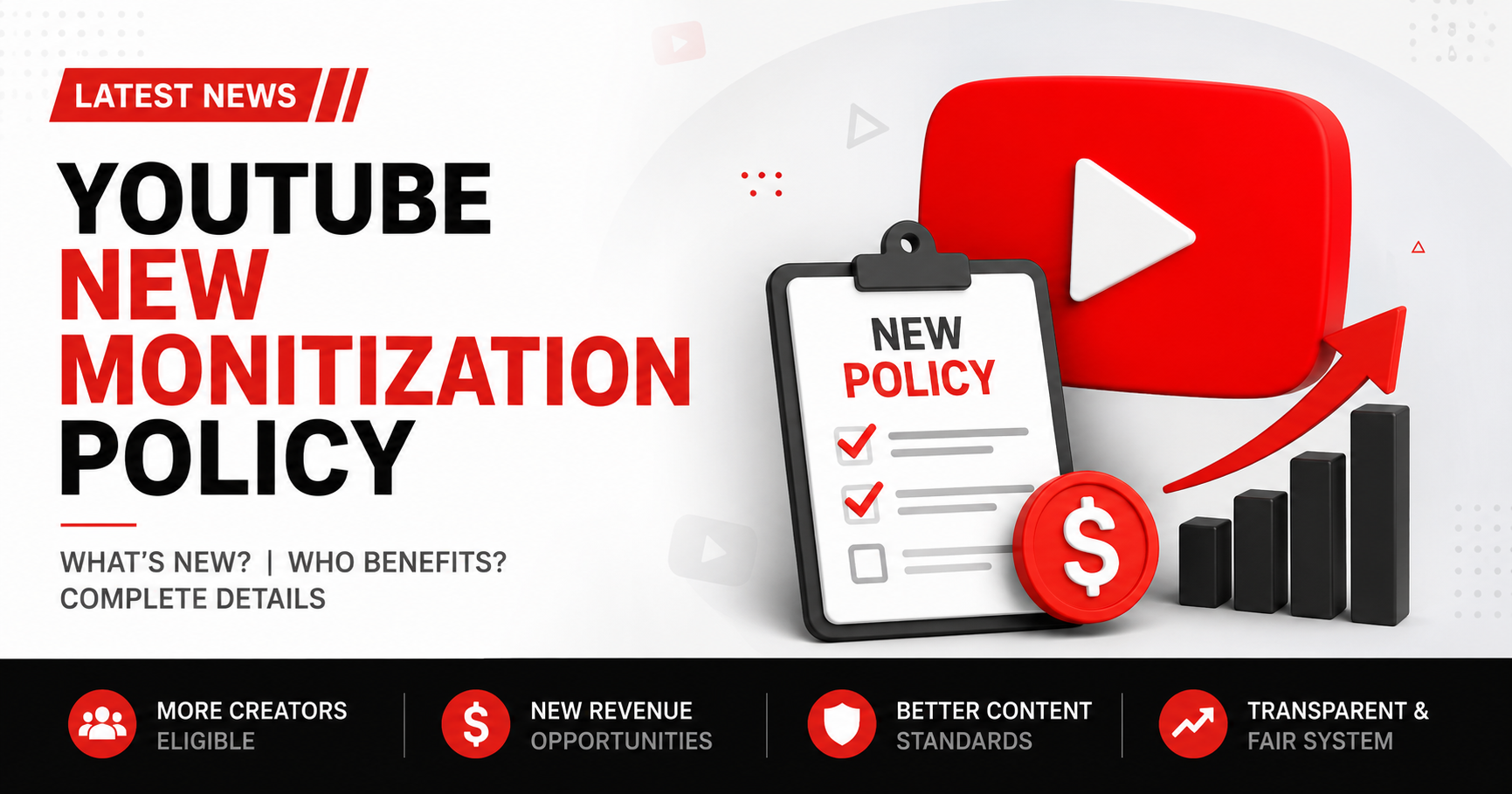
YouTube’s New Monetization Policy: What Creators Need to Know
YouTube has updated its monetization policies to put greater emphasis on original, authentic and valuable content. The changes have attracted significant attention from creators, particularly those using AI tools, automation, templates and repetitive video formats.
The important point is that YouTube is not simply banning AI-generated content. Instead, the platform is targeting content that appears to be mass-produced, repetitive or lacking meaningful original value.
What Changed?
On July 15, 2025, YouTube updated its YouTube Partner Program (YPP) guidelines to better identify what it calls “inauthentic content.”
According to YouTube, the update was intended to clarify its existing requirement that monetized content should be original and authentic, particularly as automated and mass-produced content has become more common.
This means creators who repeatedly produce videos using nearly identical templates, scripts, visuals or formats may face a greater risk of monetization problems.
Is AI Content Banned From Monetization?
No.
This is one of the biggest misconceptions surrounding the policy.
YouTube has stated that creators can continue using AI tools and that AI-assisted content can remain eligible for monetization when it follows YouTube's policies and provides original value.
For example, using AI to:
-
Brainstorm ideas
-
Write or improve a script
-
Generate captions
-
Improve audio
-
Assist with editing
-
Create graphics
-
Help with research
doesn't automatically make a channel ineligible.
The bigger issue is how the final content is produced and whether it offers meaningful value to viewers.
What Type of Content Could Be at Risk?
Channels that publish large quantities of almost identical videos with minimal human input may face problems.
Examples could include:
-
Automatically generated videos with little editing
-
Repetitive AI voice videos
-
Copy-pasted scripts
-
Videos using the same template repeatedly
-
Automatically generated slideshows
-
Content created primarily to generate views rather than provide value
-
Repetitive videos with minimal variation
-
Content that simply reads information available elsewhere
The key concern is not simply whether AI was used. The concern is whether the creator is adding meaningful originality and value.
What About Reused Content?
YouTube's reused content policy still applies.
YouTube says reused content can be monetized when viewers can clearly identify a meaningful difference between the original material and the creator's video.
For example, simply uploading someone else's:
-
TikTok clips
-
YouTube videos
-
Movie clips
-
TV footage
-
Social-media compilations
without significant original contribution can create monetization problems.
However, content that adds substantial commentary, analysis, education, storytelling or transformation can potentially qualify.
What About Reaction Videos?
Reaction and commentary channels aren't automatically banned.
The important factor is whether the creator contributes meaningful original commentary or transformation rather than simply replaying someone else's content.
This is consistent with YouTube's existing reused-content approach.
A reaction video where the creator provides genuine analysis, commentary or entertainment value is very different from a channel that simply uploads another person's video with minimal changes.
What About AI Voiceovers?
AI voiceovers aren't automatically prohibited.
However, a channel that uses an AI voice to read copied articles, news stories or other people's content over generic visuals—while producing hundreds of similar videos—could have difficulty demonstrating that the channel provides sufficient original value.
On the other hand, an original script combined with research, unique storytelling, meaningful editing and original visuals can still be eligible.
AI is a tool. The final content matters.
YouTube Is Looking for Authenticity
The broader direction of YouTube's monetization policy is straightforward:
Create content that viewers can recognize as genuinely valuable and meaningfully created.
A creator can use sophisticated tools and automation while still producing original content.
The problem begins when automation effectively replaces the creative process and produces large amounts of low-value material.
What Creators Should Do Now
If you want to protect your channel's monetization, focus on making every video meaningfully different and useful.
1. Add Your Own Perspective
Don't simply repeat information.
Add:
-
Analysis
-
Opinions
-
Examples
-
Personal experience
-
Comparisons
-
Explanations
-
Original research
2. Use AI as an Assistant
AI can help speed up production, but don't rely on it to automatically generate an entire channel.
Use AI for productivity while maintaining human control over the research, storytelling, editing and final presentation.
3. Avoid Mass Production
Publishing hundreds of nearly identical videos can make a channel look automated or repetitive.
Quality and originality are more important than simply increasing upload volume.
4. Make Your Videos Clearly Different
If every video has exactly the same:
-
Script structure
-
Voice
-
Visuals
-
Thumbnail style
-
Storytelling
-
Editing pattern
the channel may appear repetitive.
A consistent brand is fine, but the actual substance should provide genuine variation and value.
5. Don't Simply Copy Other Sources
Even if you rewrite an article or use different visuals, simply reproducing someone else's work may not provide enough original value.
Research multiple sources and build your own explanation, perspective and presentation.
What About Shorts?
YouTube Shorts are also subject to the platform's monetization policies.
YouTube specifically states that non-original Shorts—such as unedited clips from movies or TV shows, reuploads of other creators' content, and compilations without original content—can be ineligible for revenue sharing.
Shorts creators therefore need to pay attention to both originality and advertiser-friendly content requirements.
Does This Mean Existing Channels Will Automatically Lose Monetization?
No.
The policy does not mean that every channel using AI, templates or automation will automatically be demonetized.
YouTube evaluates channels against its monetization policies, and content must meet the requirements for the YouTube Partner Program.
Creators whose content is genuinely original and provides meaningful value can continue to monetize.
The Biggest Misunderstanding
The headline “YouTube bans AI content” is misleading.
The more accurate explanation is:
YouTube is becoming stricter about low-value, repetitive and mass-produced content, regardless of whether AI is involved.
A creator can use AI and still produce original content.
Likewise, a completely human-produced channel can have monetization problems if it simply reuses other people's content or produces repetitive low-value videos.
Final Thoughts
YouTube's monetization changes represent a broader shift toward quality, originality and authenticity.
AI isn't necessarily the enemy. Automation isn't automatically forbidden either.
The real question is:
Does the content provide something original and valuable to viewers?
Creators who use AI as a production tool while adding their own research, creativity, commentary, storytelling and editing are in a much stronger position than channels that simply mass-produce nearly identical videos.
For creators, the safest strategy is simple:
Use AI to improve your workflow—not to replace originality.

Comments (0)
Be the first to comment!