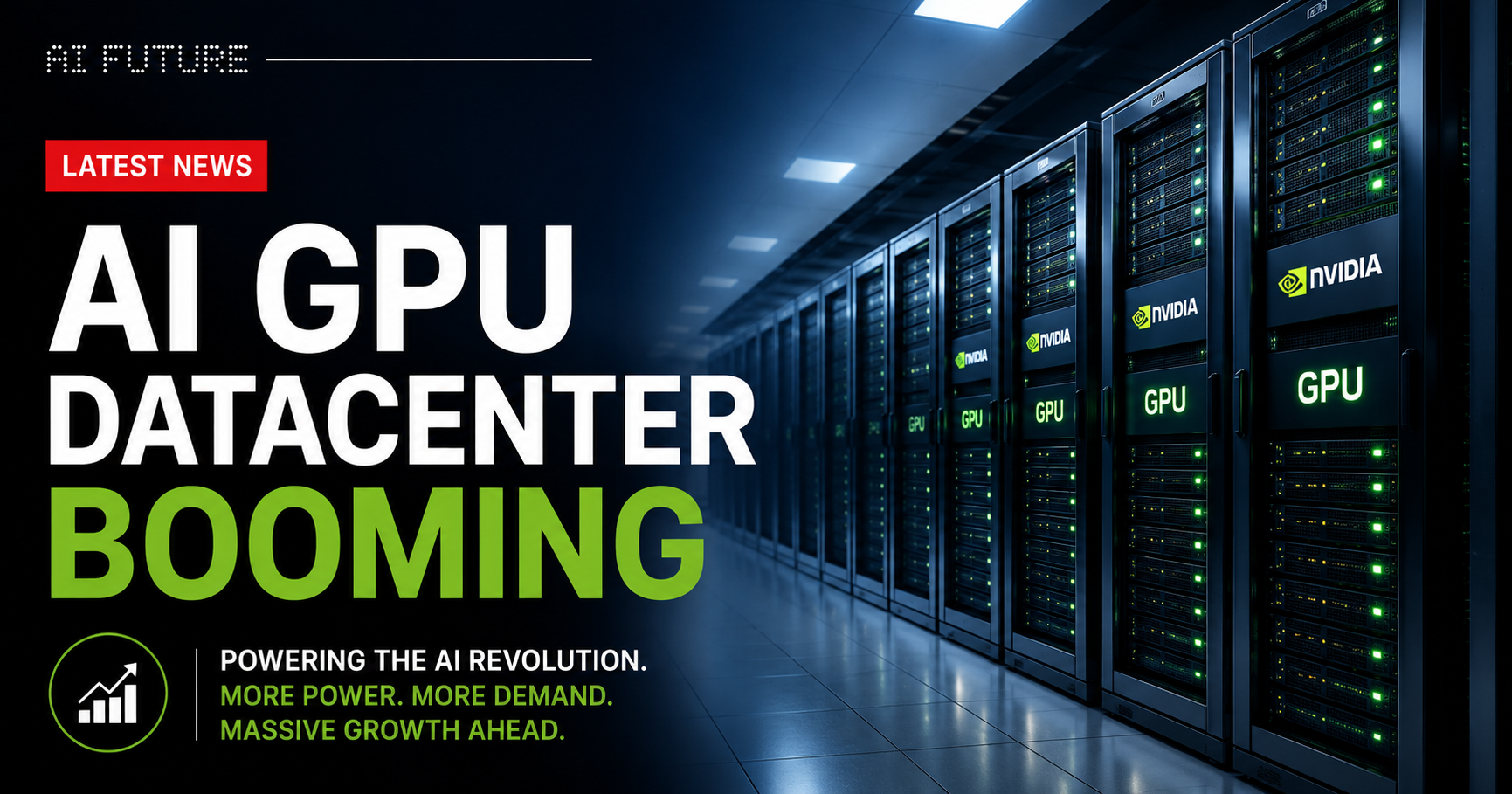
AI GPU Data Centers Are Booming: The Infrastructure Race Behind the AI Revolution
Artificial intelligence is no longer just a software story. Behind every large language model, AI assistant, image generator, coding tool and autonomous system is a massive amount of computing power.
That is driving a new infrastructure boom: AI GPU data centers.
Companies are spending billions of dollars to build facilities packed with high-performance GPUs, networking equipment, storage and advanced cooling systems. The goal is simple — provide enough computing capacity to train and run increasingly powerful AI models.
And in 2026, the expansion is accelerating.
What Is an AI GPU Data Center?
An AI GPU data center is a specialized facility designed to run large numbers of graphics processing units (GPUs) and other accelerated computing hardware.
Traditional data centers were largely designed around CPUs and conventional cloud workloads. AI workloads are different. Training and running modern AI models requires enormous amounts of parallel computation, making GPUs particularly useful.
A modern AI facility can contain:
- Thousands of GPUs
- High-speed networking
- Large-scale storage
- Liquid-cooling systems
- Powerful electrical infrastructure
- Backup power systems
- Specialized AI servers
- High-bandwidth memory
- Advanced monitoring and management systems
The result is effectively an AI computing factory capable of processing enormous numbers of calculations.
Nvidia Is at the Center of the Boom
One of the clearest signs of the AI infrastructure boom is Nvidia's data-center business.
In its second-quarter fiscal 2027 results announced on August 26, 2026, Nvidia reported $89 billion in data-center revenue, up 117% year over year. Total company revenue reached $96.2 billion, up 106% from the same quarter a year earlier.
Nvidia also expects strong demand for its next-generation computing platforms, including its Vera Rubin architecture.
This shows that the demand for AI computing isn't limited to startups experimenting with AI. Large technology companies, cloud providers and AI laboratories are investing heavily in infrastructure.
AI Server Demand Is Surging
The boom is also visible in the server market.
TrendForce estimates that the combined capital expenditure of nine major cloud service providers could exceed $886.7 billion in 2026, with the five major North American hyperscalers accounting for nearly 90% of that spending. It also raised its forecast for AI server shipments in 2026 to nearly 31% year-over-year growth.
This spending is creating demand throughout the technology supply chain.
It isn't only GPU manufacturers that benefit.
Companies involved in:
- AI servers
- Networking
- Memory
- Power systems
- Transformers
- Cooling
- Data-center construction
- Fiber connectivity
- Electrical equipment
- Data-center real estate
are all becoming increasingly important to the AI ecosystem.
Why Are Companies Building So Many AI Data Centers?
The main reason is the rapid growth in AI usage.
AI models require computing power both when they are trained and when users interact with them.
Training a frontier AI model can require enormous clusters of accelerators operating continuously. Once the model is released, millions of users can generate additional demand through queries, image generation, video generation, coding and AI agents.
As AI becomes more capable, the computing requirements can increase further.
This is creating a cycle:
More AI users → more computing demand → more GPUs → more data centers → more AI capacity → more AI applications.
AI Data Centers Need Huge Amounts of Electricity
GPUs aren't the only challenge.
A large AI data center can consume enormous amounts of electricity, making power availability one of the biggest limitations on expansion.
The International Energy Agency estimates that global data-center electricity consumption could more than double to around 945 TWh by 2030 in its base case. AI is identified as the most important driver of this growth alongside other digital services.
The energy challenge is therefore becoming an infrastructure challenge.
Developers need access to:
- Reliable electricity
- High-voltage connections
- Substations
- Transformers
- Backup generation
- Renewable energy
- Cooling water or alternative cooling systems
In some locations, getting enough electricity can take longer than constructing the actual data center.
Cooling Is Becoming Just as Important
High-performance GPUs generate substantial heat.
Traditional air cooling becomes increasingly difficult as rack power density rises, which is why liquid cooling is becoming an increasingly important technology for AI infrastructure.
Recent industry investment is spreading beyond GPUs into power and cooling equipment. Reuters reported that companies supplying electrical infrastructure and cooling systems are benefiting from the data-center expansion, with McKinsey forecasting nearly $7 trillion in global data-center investment by 2030.
This means the AI data-center boom is creating an entire infrastructure industry around the GPUs.
The Rise of AI Cloud Providers
Not every AI company wants to build its own data center.
Instead, companies can rent GPU capacity from specialized cloud providers.
This has created a rapidly growing market for GPU-as-a-service.
A startup can theoretically rent thousands of GPUs instead of spending billions building its own facility.
Recent deals demonstrate just how large this market is becoming. Anthropic, for example, reportedly signed a $35 billion cloud computing deal with Lambda for infrastructure at a Texas data center with around 350 MW of capacity.
This model is turning computing power into something that companies can purchase almost like a utility.
AI Is Changing the Data Center Business
Traditional cloud computing focused heavily on flexibility, storage and general-purpose computing.
AI infrastructure is different.
AI data centers are increasingly designed around:
Compute density + networking + power + cooling.
A facility might be built specifically around a particular GPU platform or rack architecture.
This is why data-center construction is becoming increasingly specialized.
The GPU Is Only One Part of the System
It is easy to look at AI infrastructure and think the GPU is the entire story.
It isn't.
An AI cluster requires multiple components working together.
GPUs
The GPUs perform the majority of the intensive parallel computing required by many AI workloads.
High-Bandwidth Memory
Modern AI accelerators depend heavily on fast memory to feed data to the processors.
Networking
Thousands of GPUs need to communicate with one another quickly. High-speed networking therefore becomes critical for large AI clusters.
Storage
AI systems require enormous amounts of training data and model information.
Power
The entire facility needs a reliable electrical supply.
Cooling
Heat generated by high-density computing must be continuously removed.
Software
AI infrastructure also depends on software stacks that manage GPUs, distribute workloads and optimize model performance.
The result is an extremely complex ecosystem.
The AI Infrastructure Boom Is Global
Although the United States remains a major center of AI infrastructure investment, new projects are being announced around the world.
Countries and companies are investing in domestic AI computing capacity for reasons ranging from commercial opportunity to technological independence.
However, building a data center does not automatically create complete AI independence. Many projects still depend on international GPU, networking, semiconductor and software supply chains.
India Could Become an Important Market
India is also becoming an increasingly important part of the AI infrastructure story.
The country has a large technology workforce, rapidly growing AI adoption and increasing interest in domestic computing infrastructure.
Building AI data centers in India could help companies:
- Reduce latency
- Process data locally
- Provide GPU access to Indian startups
- Support domestic AI models
- Expand cloud computing capacity
- Develop AI infrastructure expertise
However, electricity availability, land, cooling requirements, networking and the cost of high-end GPUs remain major considerations.
The Biggest Challenge: Cost
AI data centers are extremely expensive.
The costs extend far beyond purchasing GPUs.
Developers have to pay for:
- Land
- Buildings
- Electrical infrastructure
- GPUs
- Servers
- Networking
- Cooling
- Backup power
- Fiber connectivity
- Security
- Maintenance
- Operations
And GPUs can become outdated as newer generations arrive.
This creates a difficult investment equation: operators need to keep facilities highly utilized while upgrading hardware fast enough to remain competitive.
Is the AI Data Center Boom Sustainable?
That is one of the biggest questions facing the technology industry.
The demand for AI infrastructure is clearly enormous, but investors are increasingly asking whether all this capacity will generate enough revenue to justify the cost.
There are reasons for optimism.
AI is increasingly being used for:
- Software development
- Customer service
- Search
- Business automation
- Scientific research
- Video generation
- Robotics
- Data analysis
- Enterprise applications
- AI agents
At the same time, efficiency improvements are reducing the amount of energy needed for some individual AI tasks.
The IEA notes that hardware and software improvements have significantly reduced energy consumption per AI task, even as overall AI usage continues to grow.
So the future will depend on a balance between rapid AI adoption and improving computing efficiency.
The Next Phase Could Be Even Bigger
The AI infrastructure industry is moving beyond simply building more GPU clusters.
The next generation of facilities is likely to focus on:
- Higher GPU density
- Liquid cooling
- Faster networking
- Specialized AI accelerators
- Renewable energy
- Nuclear and other firm power sources
- AI-specific data-center designs
- More efficient chips
- Larger AI clusters
Nvidia's latest financial outlook is another indication that the company expects AI infrastructure demand to remain strong. Its Q2 fiscal 2027 results showed data-center revenue more than doubling year over year, while the company projected continued strong growth.
Final Thoughts
The AI GPU data-center boom is becoming one of the largest infrastructure buildouts in the technology industry.
The story is no longer simply about who creates the best AI model. Increasingly, it is also about who has access to enough computing power to train, deploy and operate those models at scale.
That is why billions of dollars are flowing into GPUs, servers, networking, electricity, cooling and data-center construction.
The companies building AI applications may get the most attention, but behind them is an enormous infrastructure industry quietly expanding around the world.
The AI revolution needs computing power — and the race to build that computing infrastructure has only just begun.



Comments (0)
Be the first to comment!
Leave a Comment